CJC-1295 (DAC)
0.8 mgYaDAIFTQSYRKVLAQLSARKLLQDILSRK(maleimidopropionyl)NH2 (a = D-Ala)
- Molecular formula
- C165H269N47O46
- Molecular weight
- 3647.2 g/mol
- CAS number
- 446262-90-4
- PubChem CID
- 91971820
- Length
- 30 amino acids
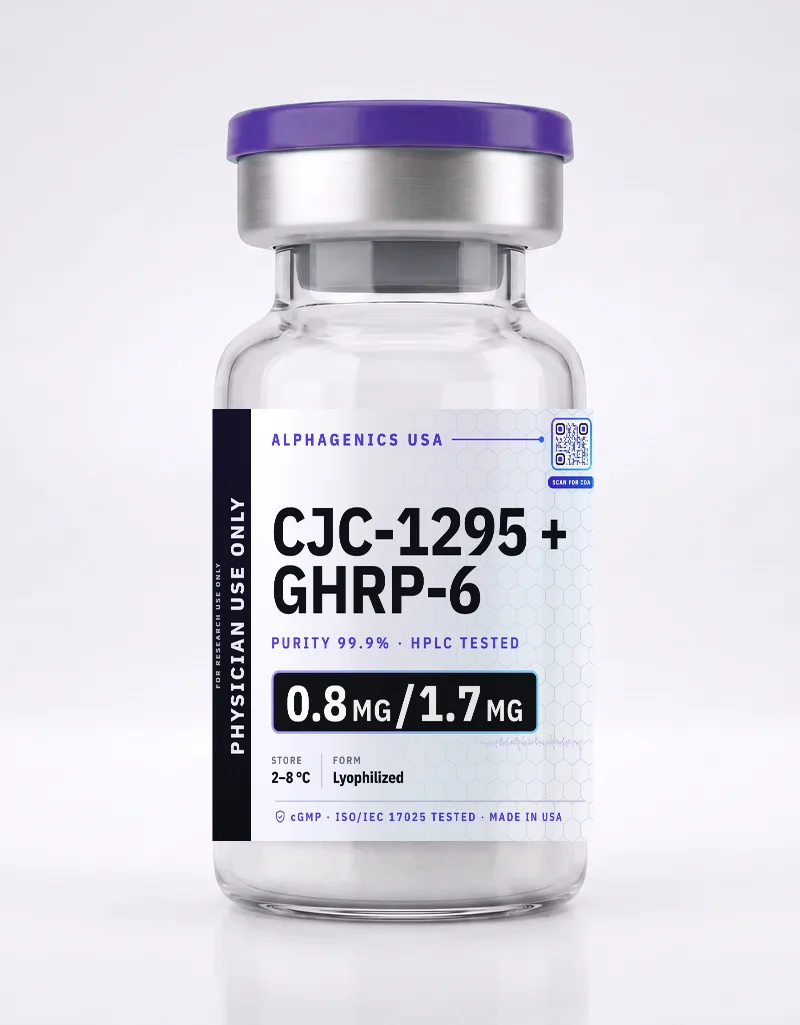
CJC-1295 / GHRP-6
Combination of a GHRH analog + GH secretagogue (GHS-R1a)
This presentation combines two peptides that act on complementary pathways of growth hormone release.
CJC-1295 is a tetrasubstituted GHRH (1-29) analog that acts on the GHRH receptor of the pituitary; the version with drug affinity complex (DAC) binds covalently to albumin and extends its half-life to several days. GHRP-6 acts on the ghrelin receptor (GHS-R1a). In the literature, simultaneous stimulation of both pathways has been associated with synergistic GH release, greater than the sum of each stimulus separately.
Quick guide · 5 key points
This blend pairs a long-acting GHRH analog with a ghrelin-receptor secretagogue, two separate pathways for growth hormone (GH) release. Here are five things the research shows.
CJC-1295 is a GHRH analog that acts on the pituitary GHRH receptor. GHRP-6 acts on the GH secretagogue receptor, the same one used by ghrelin. These are two independent pathways that control GH release.1,2,3,5,6
In healthy men, GHRH given with GHRP-6 at submaximal doses has been shown to produce synergistic GH release, greater than either peptide alone. That study used natural GHRH, not CJC-1295; there are no published studies of this specific blend.1
In healthy adults, a single dose of CJC-1295 was associated with 2- to 10-fold higher GH for 6 days or more and 1.5- to 3-fold higher IGF-1 for 9 to 11 days. Its estimated half-life was 5.8 to 8.1 days.4
In healthy men aged 20 to 40, one week after a dose of CJC-1295, GH kept its pulsatile pattern, with the same pulse frequency. Baseline GH rose 7.5-fold, mean GH by 46% and IGF-1 by 45%.2
In CJC-1295 trials in healthy adults, no serious adverse reactions were reported. With GHRP-6 in healthy men there were no clinical adverse effects, but at the highest dose prolactin and cortisol rose about 2-fold. Safety data come from each component on its own.4,1
Reference amounts of the formulation. The physicochemical data correspond to each individual peptide.
Summary of results reported in the scientific literature. Each finding describes what was observed in the cited study, in its specific population and conditions; it does not constitute a therapeutic indication.
In healthy adults, a single dose of CJC-1295 has shown sustained increases in plasma GH (2- to 10-fold for 6 days or more) and in IGF-1 (1.5- to 3-fold for 9 to 11 days).
Teichman SL et al. J Clin Endocrinol Metab. 2006;91:799-805 · PMID 16352683In healthy men, after a dose of CJC-1295, GH secretion has been observed to retain its pulsatile pattern, with a marked increase in basal (trough) secretion and in IGF-1.
Ionescu M, Frohman LA. J Clin Endocrinol Metab. 2006;91:4792-4797 · PMID 17018654In GHRH-deficient mice, daily administration of CJC-1295 has normalized body growth; with 48- or 72-hour intervals the effect was smaller.
Alba M et al. Am J Physiol Endocrinol Metab. 2006;291:E1290-E1294 · PMID 16822960In healthy men, the combination of GHRH with GHRP-6 at submaximal doses has shown synergistic GH release, greater than that of each peptide separately.
Bowers CY et al. J Clin Endocrinol Metab. 1990;70:975-982 · PMID 2108187In a porcine model of myocardial infarction, GHRP-6 has been associated with a 78% reduction in infarct mass versus saline.
Berlanga J et al. Clin Sci (Lond). 2007;112:241-250 · PMID 16989643