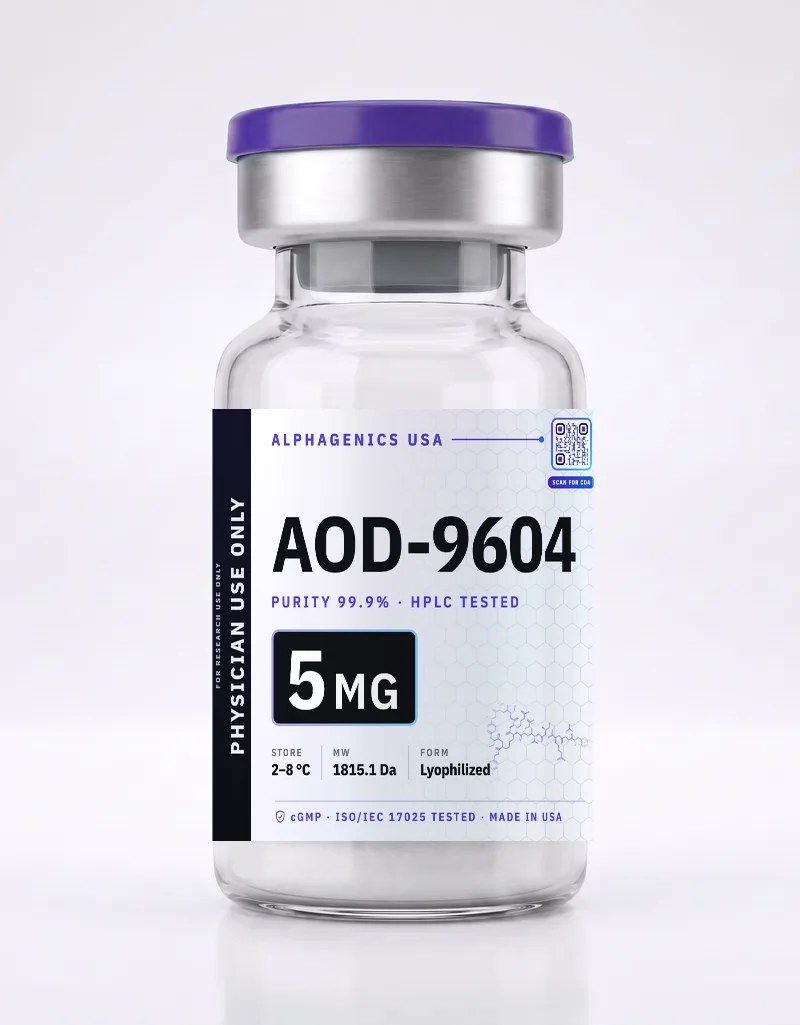
AOD-9604
Modified hGH fragment 176-191 · Tyr-hGH 177-191
Modified C-terminal fragment of human growth hormone
About AOD-9604
AOD-9604 is a 16-amino-acid peptide that reproduces the C-terminal region (residues 177-191) of human growth hormone, with an additional tyrosine at the N-terminus.
This region has been associated with the effects of GH on fat metabolism. Unlike full-length GH, in published studies it has not shown effects on IGF-1 or on blood glucose. Its clinical development as an anti-obesity agent did not demonstrate efficacy in phase 2b, so the evidence of interest is concentrated in preclinical and safety studies.
Quick guide · 5 key points
AOD-9604: a fragment of growth hormone
AOD-9604 reproduces the end of growth hormone linked to its effects on fat. Here are five things the research shows.
-
1
A GH fragment that skips the GH receptor
AOD-9604 is a 16-amino-acid peptide (Tyr-hGH 177-191) taken from the C-terminal end of growth hormone. In lab studies it did not compete for the GH receptor and did not drive cell proliferation, unlike full-length GH.1,2
16Amino acids, taken from the C-terminal end of GH -
2
More fat burning in obese rodents
In obese mice treated for 14 days, AOD-9604 was associated with less weight gain, more fat oxidation and more lipolysis, without high blood sugar. In obese Zucker rats, 19 days of oral dosing cut weight gain by more than 50%, without affecting insulin sensitivity.2,3
>50%Less weight gain in obese Zucker rats (19 days) -
3
Cartilage regeneration in an animal model
In a knee osteoarthritis model in 32 rabbits, injections of AOD-9604 into the joint were associated with greater cartilage regeneration. Combined with hyaluronic acid, it worked better than either one alone and shortened the period of lameness.4
32Rabbits with induced knee osteoarthritis in the study -
4
No effect on IGF-1 or blood sugar
A review of six randomized, placebo-controlled trials in humans found no change in serum IGF-1 and no negative effect on oral glucose tolerance tests. No antibodies against the peptide were detected, and tolerability was similar to placebo.1
6Placebo-controlled trials included in the safety review -
5
No significant weight loss in phase 2b
In a phase 2b trial (536 adults with obesity enrolled, 24 weeks, oral), AOD-9604 did not produce significantly more weight loss than placebo, and its development for obesity was stopped. According to the FDA, most of the human studies it identified showed no weight benefit over placebo.5
536Adults with obesity enrolled in the phase 2b trial
References
- Stier H, et al. Safety and tolerability of the hexadecapeptide AOD9604 in humans. J Endocrinol Metab. 2013;3(1-2):7-15. Official source
- Heffernan MA, et al. Increase of fat oxidation and weight loss in obese mice caused by chronic treatment with human growth hormone or a modified C-terminal fragment. Int J Obes Relat Metab Disord. 2001;25(10):1442-9. PMID 11673763
- Ng FM, et al. Metabolic studies of a synthetic lipolytic domain (AOD9604) of human growth hormone. Horm Res. 2000;53(6):274-8. PMID 11146367
- Kwon DR, Park GY. Effect of intra-articular injection of AOD9604 with or without hyaluronic acid in rabbit osteoarthritis model. Ann Clin Lab Sci. 2015;45(4):426-32. PMID 26275694
- U.S. Food and Drug Administration. FDA briefing document: AOD-9604-related bulk drug substances. Pharmacy Compounding Advisory Committee meeting, December 4, 2024. Official source
Structure and sequence
Sequence

Five findings from studies
Summary of results reported in the scientific literature. Each finding describes what was observed in the cited study, in its specific population and conditions; it does not constitute a therapeutic indication.
-
Preclinical
In obese mice, AOD-9604 has shown a reduction in body-weight gain, together with increased fat oxidation and lipolysis, without binding to the GH receptor.
Heffernan MA et al. Int J Obes Relat Metab Disord. 2001;25:1442-1449 · PMID 11673763 -
Preclinical
In obese Zucker rats, oral administration of AOD-9604 for 19 days has shown a reduction of more than 50% in body-weight gain and an increase in adipose-tissue lipolytic activity, without affecting insulin sensitivity.
Ng FM et al. Horm Res. 2000;53:274-278 · PMID 11146367 -
Clinical study
In human safety studies, no changes in serum IGF-1 or in glucose tolerance have been observed, with a tolerability profile similar to placebo.
Stier H et al. J Endocrinol Metab. 2013;3:7-15 -
Preclinical
In a rabbit model of knee osteoarthritis, intra-articular injection of AOD-9604 together with hyaluronic acid has been associated with greater cartilage regeneration.
Kwon DR, Park GY. Ann Clin Lab Sci. 2015;45:426-432 · PMID 26275694 -
Clinical study
In a 24-week phase 2b trial (536 adults with obesity enrolled), oral AOD-9604 has not shown a body-weight reduction significantly greater than placebo; this result is reported for a complete reading of the evidence.
Metabolic Pharmaceuticals Ltd. Phase 2b results announcement (21 Feb 2007); summarized in FDA, PCAC Briefing Document, 4 Dec 2024