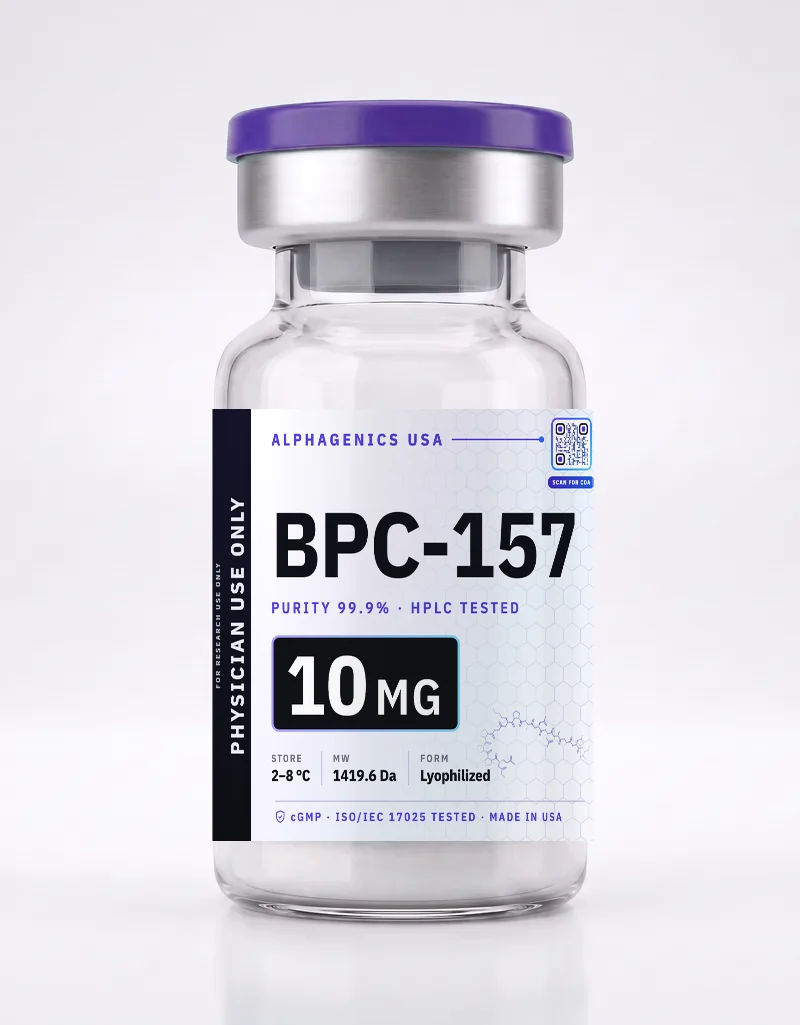
BPC-157
Body Protection Compound-157 · PL 14736 · Bepecin
Pentadecapeptide derived from a gastric protein
About BPC-157
BPC-157 is a synthetic pentadecapeptide whose sequence derives from a protein found in human gastric juice.
It is stable in the gastric environment and has been the subject of a broad body of preclinical research, mainly from the University of Zagreb group, on the healing of tendons, ligaments, muscle, the gastrointestinal tract and blood vessels. Proposed mechanisms include modulation of the nitric oxide pathway, activation of VEGFR2 signaling and fibroblast migration. Evidence in humans is still limited.
Quick guide · 5 key points
BPC-157 and tissue repair
BPC-157 is a 15-amino-acid peptide derived from a protein in human gastric juice, studied mostly in animal injury models. Here are five things the research shows.
-
1
A stable fragment of a gastric protein
BPC-157 is a partial sequence of a protein isolated from human gastric juice. In tendon fibroblasts it has been associated with greater cell migration and survival (FAK-paxillin pathway), and in endothelial cells with VEGFR2 activation, the receptor that drives new vessel formation.1,2
15 aaPeptide length, derived from a gastric juice protein -
2
Better Achilles tendon healing in rats
In rats with a transected Achilles tendon, BPC-157 has been associated with better functional, biomechanical and histological recovery: higher load to failure, smaller defects and better collagen formation than in controls.3
14 daysTendon follow-up in the rat transection model -
3
Blood vessels and the digestive tract
In rats with hind-limb ischemia, BPC-157 has been associated with faster recovery of blood flow and more vessels. In rats with intestinal fistulas and anastomoses, accelerated healing has been observed, even when treatment was delayed by a month.2,4
1 monthtreatment delay, with fistula closure still observed in rats -
4
A short half-life in animal studies
In rats and dogs, the elimination half-life of BPC-157 was under 30 minutes. Bioavailability after intramuscular injection was 14–19% in rats and 45–51% in dogs. It is broken down quickly into small fragments and amino acids, cleared through urine and bile.5
< 30 minElimination half-life in rats and dogs -
5
The evidence is almost all preclinical
A 2025 systematic review included 36 studies: 35 preclinical and 1 clinical, and found no clinical safety data. In humans there is only an uncontrolled retrospective series (11 of 12 patients with knee pain reported improvement) and an intravenous pilot in 2 people.6,7,8
35 of 36studies in the systematic review were preclinical
References
- Chang CH, et al. The promoting effect of pentadecapeptide BPC 157 on tendon healing involves tendon outgrowth, cell survival, and cell migration. J Appl Physiol (1985). 2011;110(3):774-80. PMID 21030672
- Hsieh MJ, et al. Therapeutic potential of pro-angiogenic BPC157 is associated with VEGFR2 activation and up-regulation. J Mol Med (Berl). 2017;95(3):323-333. PMID 27847966
- Staresinic M, et al. Gastric pentadecapeptide BPC 157 accelerates healing of transected rat Achilles tendon and in vitro stimulates tendocytes growth. J Orthop Res. 2003;21(6):976-83. PMID 14554208
- Sikiric P, et al. Stable gastric pentadecapeptide BPC 157: novel therapy in gastrointestinal tract. Curr Pharm Des. 2011;17(16):1612-32. PMID 21548867
- He L, et al. Pharmacokinetics, distribution, metabolism, and excretion of body-protective compound 157, a potential drug for treating various wounds, in rats and dogs. Front Pharmacol. 2022;13:1026182. PMID 36588717
- Vasireddi N, et al. Emerging use of BPC-157 in orthopaedic sports medicine: a systematic review. HSS J. 2025;21(4):485-495. PMID 40756949
- Lee E, Padgett B. Intra-articular injection of BPC 157 for multiple types of knee pain. Altern Ther Health Med. 2021;27(4):8-13. PMID 34324435
- Lee E, Burgess K. Safety of intravenous infusion of BPC157 in humans: a pilot study. Altern Ther Health Med. 2025;31(5):20-24. PMID 40131143
Structure and sequence
Sequence

Five findings from studies
Summary of results reported in the scientific literature. Each finding describes what was observed in the cited study, in its specific population and conditions; it does not constitute a therapeutic indication.
-
Preclinical
In a rat Achilles tendon transection model, BPC-157 has been associated with better functional, biomechanical and histological recovery of the tendon.
Staresinic M et al. J Orthop Res. 2003;21:976-983 · PMID 14554208 -
In vitro
In tendon fibroblasts, BPC-157 has shown increased cell migration and survival under oxidative stress, likely mediated by activation of the FAK-paxillin pathway.
Chang CH et al. J Appl Physiol (1985). 2011;110:774-780 · PMID 21030672 -
Preclinical
In a rat hindlimb ischemia model, BPC-157 has been associated with faster recovery of blood flow and increased angiogenesis, associated with VEGFR2 activation.
Hsieh MJ et al. J Mol Med. 2017;95:323-333 · PMID 27847966 -
Review
In a review by the University of Zagreb group (Sikiric et al.), BPC-157 is described as having been associated with accelerated healing in multiple rat models of gastrointestinal injury (ulcers, fistulas, anastomoses).
Sikiric P et al. Curr Pharm Des. 2011;17:1612-1632 · PMID 21548867 -
Clinical study
In a retrospective series (telephone follow-up of 16 patients with various types of knee pain), 11 of the 12 who received intra-articular BPC-157 alone reported significant pain improvement; this is preliminary evidence, without a control group or standardized functional scales.
Lee E, Padgett B. Altern Ther Health Med. 2021;27:8-13 · PMID 34324435