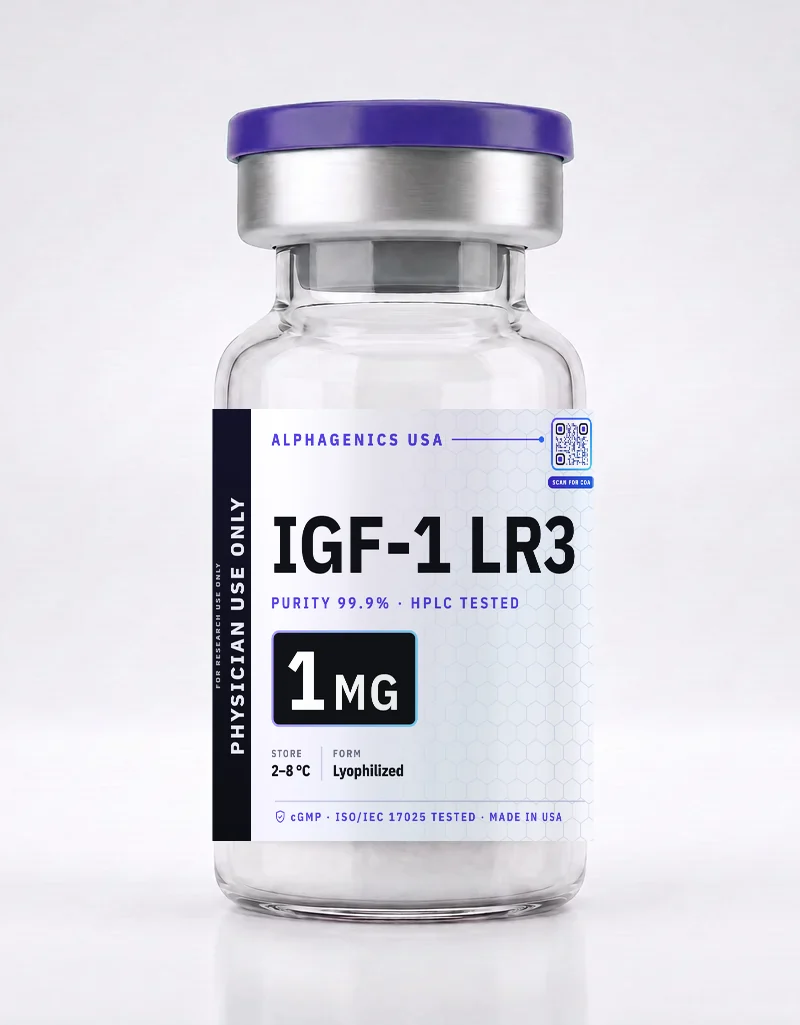
IGF-1 LR3
Long R3 IGF-I · LR3-IGF-1
Insulin-like growth factor-1 analog
About IGF-1 LR3
IGF-1 LR3 is a recombinant analog of human insulin-like growth factor-1 (IGF-1).
It has two modifications: the substitution of glutamic acid with arginine at position 3 and a 13-amino-acid N-terminal extension. Both markedly reduce its binding to IGF-binding proteins (IGFBPs), which increases the free fraction and has been associated with greater biological potency in cell culture and in rats. This does not prolong its time in the blood: in rats, LR3 was cleared from plasma about 11 times faster than native IGF-1. It is used as a cell-culture media supplement in biotechnology and is not approved for use in humans.
Quick guide · 5 key points
IGF-1 LR3 and the IGF-binding proteins
IGF-1 LR3 is an analog of insulin-like growth factor 1 designed to bind weakly to the proteins that normally hold it inactive in the blood. Here are five things the research shows.
-
1
Two changes that free it from IGFBPs
LR3 has arginine in place of glutamic acid at position 3 and an N-terminal extension. In cell culture, these analogs have been shown to have weaker interaction with IGF-binding proteins (IGFBPs) and greater potency than native IGF-1 in cells that make IGFBPs.1
Arg3The key change that reduces IGFBP binding -
2
More potent than IGF-1 in growing rats
In growing female rats, 14 days of LR3 was associated with more weight gain, better nitrogen retention and greater feed efficiency. 44 µg/day of LR3 produced effects similar to 278 µg/day of native IGF-1.2
44 vs 278µg/day of LR3 vs IGF-1 for a similar effect, in rats -
3
Anabolic effect in catabolic states
In dexamethasone-treated rats, a model of tissue wasting, LR3 was about 2.5 times more potent than IGF-1 at partly reversing weight and nitrogen loss, despite binding about 3 times less well to its receptor. In rats with bowel resection it was associated with less malabsorption.3,4
≈ 2.5×Potency vs native IGF-1, in catabolic rats -
4
It circulates free and clears faster
In non-pregnant rats, most labeled LR3 was found in the blood as free peptide, while IGF-1 circulated mainly bound in an IGFBP complex. LR3 was cleared from plasma almost 11 times faster than IGF-1 (9.84 vs 0.90 mL/min/kg). After an intramuscular injection in rats, intact LR3 was no longer detectable after 4 h.5,8
≈ 11×Faster plasma clearance than IGF-1, in rats -
5
No human trials
LR3 is not approved for human use and there are no published clinical trials: the data come from rats and cell culture, where it is used as an alternative to insulin in biotech production media. With approved native IGF-1 (mecasermin), hypoglycemia was seen in 42% of patients treated in clinical studies.6,7,8
42%Hypoglycemia with native IGF-1 (mecasermin) in clinical studies
References
- Francis GL, et al. Novel recombinant fusion protein analogues of insulin-like growth factor (IGF)-I indicate the relative importance of IGF-binding protein and receptor binding for enhanced biological potency. J Mol Endocrinol. 1992;8(3):213-23. PMID 1378742
- Tomas FM, et al. Anabolic effects of insulin-like growth factor-I (IGF-I) and an IGF-I variant in normal female rats. J Endocrinol. 1993;137(3):413-21. PMID 8371075
- Tomas FM, et al. Insulin-like growth factor-I (IGF-I) and especially IGF-I variants are anabolic in dexamethasone-treated rats. Biochem J. 1992;282(Pt 1):91-7. PMID 1371669
- Lemmey AB, et al. Treatment with IGF-I peptides improves function of the remnant gut following small bowel resection in rats. Growth Factors. 1994;10(4):243-52. PMID 7803042
- Bastian SE, et al. Plasma clearance and tissue distribution of labelled insulin-like growth factor-I (IGF-I) and an analogue LR3IGF-I in pregnant rats. J Endocrinol. 1993;138(2):327-36. PMID 7693845
- Morris AE, Schmid J. Effects of insulin and LongR(3) on serum-free Chinese hamster ovary cell cultures expressing two recombinant proteins. Biotechnol Prog. 2000;16(5):693-7. PMID 11027158
- U.S. Food and Drug Administration. Increlex (mecasermin [rDNA origin] injection) prescribing information. NDA 21-839, 2005. Official source
- Mongongu C, et al. Detection of LongR(3) -IGF-I, Des(1-3)-IGF-I, and R(3) -IGF-I using immunopurification and high resolution mass spectrometry for antidoping purposes. Drug Test Anal. 2021;13(7):1256-69. PMID 33587816
Structure and sequence
Sequence

Five findings from studies
Summary of results reported in the scientific literature. Each finding describes what was observed in the cited study, in its specific population and conditions; it does not constitute a therapeutic indication.
-
In vitro
In their original characterization, the Long IGF-I analogs (including Long [Arg3]-IGF-I, or LR3) have shown reduced interaction with IGFBPs and greater biological potency than native IGF-1 in cell lines that secrete IGFBPs (in fibroblasts that do not secrete them, LR3 was less potent than IGF-1).
Francis GL et al. J Mol Endocrinol. 1992;8:213-223 · PMID 1378742 -
Preclinical
In growing rats, LR3 IGF-I has been associated with greater weight gain, better nitrogen retention and greater feed efficiency, with substantially higher potency than native IGF-1 (44 µg/day produced effects similar to 278 µg/day of IGF-1).
Tomas FM et al. J Endocrinol. 1993;137:413-421 · PMID 8371075 -
Preclinical
In rats with catabolic states, an improvement in nitrogen balance has been observed with IGF-1 analogs with low affinity for IGFBPs.
Tomas FM et al. Biochem J. 1992;282:91-97 · PMID 1371669 -
Preclinical
In rats with partial resection of the small intestine, administration of IGF-1 and of LR3 IGF-I has been associated with less fat and nitrogen malabsorption and greater growth of the remaining intestine.
Lemmey AB et al. Growth Factors. 1994;10:243-252 · PMID 7803042 -
In vitro
In serum-free CHO cell cultures, LongR3 IGF-I has been shown to maintain cell viability under production conditions better than insulin, which is why it is used as an insulin substitute in culture media for biotechnological production.
Morris AE, Schmid J. Biotechnol Prog. 2000;16:693-697 · PMID 11027158