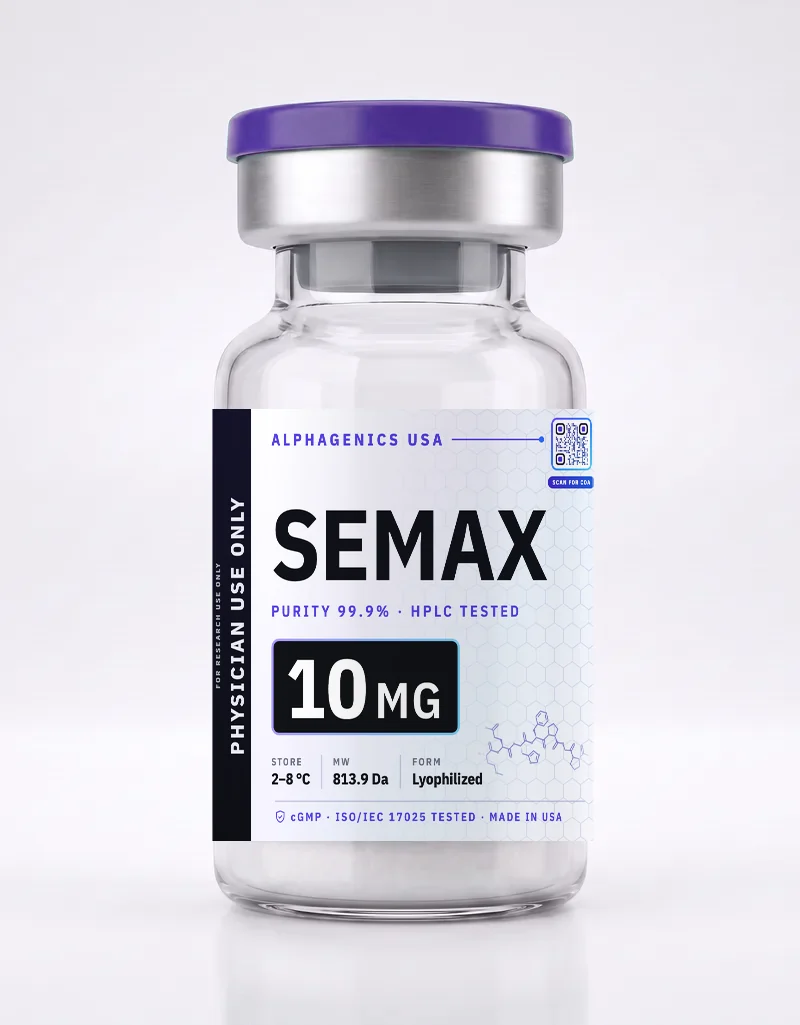
Semax
ACTH (4-7)-Pro-Gly-Pro · Met-Glu-His-Phe-Pro-Gly-Pro
Synthetic heptapeptide, ACTH (4-10) analog
About Semax
Semax is a synthetic heptapeptide derived from the ACTH (4-7) fragment of adrenocorticotropic hormone, to which the Pro-Gly-Pro sequence was added to prolong its stability.
It has no hormonal activity on the adrenal gland. It was developed at the Institute of Molecular Genetics of the Russian Academy of Sciences and is registered in Russia for the treatment of ischemic stroke and cognitive disorders. It has been studied for its relationship with the expression of neurotrophic factors such as BDNF.
Quick guide · 5 key points
Semax, BDNF and brain function
Semax is a synthetic heptapeptide analogue of the ACTH (4-10) fragment, studied for its link to BDNF, a nerve growth factor. Here are five things the research shows.
-
1
An ACTH analogue with its own binding sites
Semax (Met-Glu-His-Phe-Pro-Gly-Pro) is an analogue of the ACTH (4-10) fragment. Specific binding sites for the peptide have been found in the rat basal forebrain, and a nasal dose was associated with a rapid rise in BDNF protein there, but not in the cerebellum.1
3 huntil BDNF rose in rats after a nasal dose -
2
BDNF, TrkB and learning in rats
In rats, a single dose of Semax was associated with a 1.4-fold increase in BDNF protein and a 1.6-fold increase in activation of its TrkB receptor in the hippocampus. Treated animals showed more conditioned avoidance responses, a measure of learning.2
1.4×more BDNF protein in rat hippocampus after one dose -
3
Recovery after ischemic stroke
In a study of 110 patients after ischemic stroke, those who received Semax had higher plasma BDNF levels throughout the study and improved faster on the Barthel index, a scale of functional independence.3
110patients after ischemic stroke in the study -
4
It reaches the brain fast and breaks down fast
In rats, after a nasal dose, labeled Semax was detected in the brain within 2 minutes, mostly as intact peptide. It then undergoes rapid enzymatic breakdown, and the Pro-Gly-Pro fragment becomes the main product.4
2 minuntil detected in rat brain after a nasal dose -
5
A mechanism still under study
Much of the evidence comes from rats and Russian research groups. In a rat model of brain ischemia, the authors noted that its molecular mechanism remains unclear, and observed that Semax was mainly associated with changes in immune-system and vascular genes.5
>50%of the genes changed in rats were immune-related
References
- Dolotov OV, et al. Semax, an analogue of adrenocorticotropin (4-10), binds specifically and increases levels of brain-derived neurotrophic factor protein in rat basal forebrain. J Neurochem. 2006;97 Suppl 1:82-6. PMID 16635254
- Dolotov OV, et al. Semax, an analog of ACTH(4-10) with cognitive effects, regulates BDNF and trkB expression in the rat hippocampus. Brain Res. 2006;1117(1):54-60. PMID 16996037
- Gusev EI, et al. The efficacy of semax in the treatment of patients at different stages of ischemic stroke. Zh Nevrol Psikhiatr Im S S Korsakova. 2018;118(3 Vyp 2):61-68. PMID 29798983
- Shevchenko KV, et al. Kinetics of Semax penetration into the brain and blood of rats after its intranasal administration. Bioorg Khim. 2006;32(1):64-70. PMID 16523722
- Medvedeva EV, et al. The peptide semax affects the expression of genes related to the immune and vascular systems in rat brain focal ischemia: genome-wide transcriptional analysis. BMC Genomics. 2014;15:228. PMID 24661604
Structure and sequence
Sequence

Five findings from studies
Summary of results reported in the scientific literature. Each finding describes what was observed in the cited study, in its specific population and conditions; it does not constitute a therapeutic indication.
-
Preclinical
In rats, intranasal administration of Semax has shown a rapid increase in BDNF protein levels in the basal forebrain, where specific binding sites for the peptide were identified.
Dolotov OV et al. J Neurochem. 2006;97 Suppl 1:82-86 · PMID 16635254 -
Clinical study
In patients with ischemic stroke, administration of Semax has been associated with better functional recovery and with changes in plasma BDNF levels.
Gusev EI et al. Zh Nevrol Psikhiatr Im S S Korsakova. 2018;118:61-68 · PMID 29798983 -
Preclinical
In a rat model of cerebral ischemia, Semax has been observed to modulate the expression of genes related to inflammation and the vascular system.
Medvedeva EV et al. BMC Genomics. 2014;15:228 · PMID 24661604 -
Preclinical
In rats, a single dose of Semax has shown an increase in BDNF levels and in the phosphorylation of its TrkB receptor in the hippocampus, together with a greater number of conditioned avoidance responses (learning).
Dolotov OV et al. Brain Res. 2006;1117:54-60 · PMID 16996037 -
Regulatory
Semax is registered in the Russian Federation for intranasal use in ischemic stroke and cognitive disorders.
State Register of Medicines of the Russian Federation