Semax
5 mgM1E2H3F4P5G6P7
- Molecular formula
- C37H51N9O10S
- Molecular weight
- 813.9 g/mol
- CAS number
- 80714-61-0
- PubChem CID
- 9811102
- Length
- 7 aa
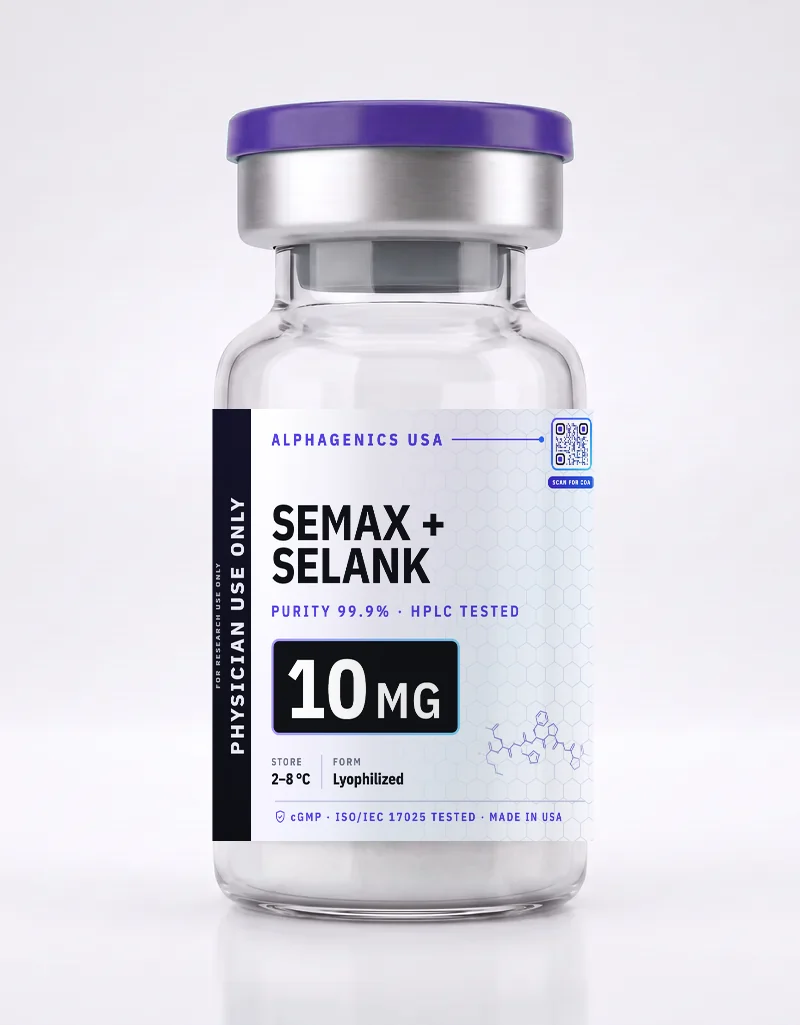
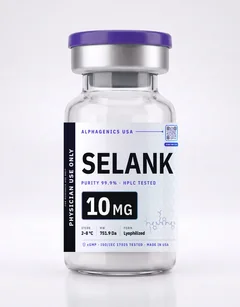
Semax + Selank
Combination of neuroactive heptapeptides
This presentation combines two synthetic heptapeptides developed at the Institute of Molecular Genetics of the Russian Academy of Sciences.
Both share the C-terminal stabilizing sequence Pro-Gly-Pro. Semax, derived from ACTH (4-7), has been studied for its relationship with BDNF and cognitive function; Selank, derived from tuftsin, for its anxiolytic activity and its possible action on the GABAergic system. The combination brings both lines of research together in a single vial.
Quick guide · 5 key points
This blend combines two synthetic heptapeptides with the same stabilizing tail: Semax, studied for BDNF, and Selank, studied for anxiety. Here are five things the research shows.
Semax (Met-Glu-His-Phe-Pro-Gly-Pro) is an ACTH (4-10) analogue and Selank (Thr-Lys-Pro-Arg-Pro-Gly-Pro) is a tuftsin analogue. Both end in Pro-Gly-Pro, and they are combined because they have been studied along two different lines: cognitive function and anxiety.1,2
In rats, a single dose of Semax was associated with a 1.4-fold rise in BDNF in the hippocampus. In a study of 110 patients after ischemic stroke, it was associated with higher plasma BDNF and faster functional recovery.3,4
In 62 patients with generalized anxiety disorder and neurasthenia, Selank showed an anti-anxiety effect similar to medazepam, with additional anti-fatigue effects.5
In vitro, both have been shown to inhibit the human serum enzymes that break down enkephalins (IC50 10 µM for Semax, 20 µM for Selank). In 52 healthy volunteers, each one given separately was associated with changes in amygdala connectivity on functional MRI.1,6
The studies cited tested each peptide on its own; none tested the blend in one vial. In rats with a Parkinson's model, Selank was associated with less anxiety and neither peptide changed motor activity. The evidence is mostly preclinical and from Russian groups.2,6,3,5
Reference amounts of the formulation. The physicochemical data correspond to each individual peptide.
Summary of results reported in the scientific literature. Each finding describes what was observed in the cited study, in its specific population and conditions; it does not constitute a therapeutic indication.
Semax: in rats it has shown an increase in BDNF levels and in TrkB activation in the hippocampus.
Dolotov OV et al. Brain Res. 2006;1117:54-60 · PMID 16996037Semax: in patients with ischemic stroke it has been associated with better functional recovery.
Gusev EI et al. Zh Nevrol Psikhiatr Im S S Korsakova. 2018;118:61-68 · PMID 29798983Selank: in patients with generalized anxiety disorder and neurasthenia it has shown an anxiolytic effect similar to that of medazepam.
Zozulia AA et al. Zh Nevrol Psikhiatr Im S S Korsakova. 2008;108:38-48 · PMID 18454096Selank: in rats subjected to chronic stress it has reduced anxiety indicators and has potentiated the anxiolytic effect of diazepam.
Kasian A et al. Behav Neurol. 2017;2017:5091027 · PMID 28280289Selank: in in vitro studies it has shown inhibition of enzymes that degrade enkephalins.
Kost NV et al. Bioorg Khim. 2001;27:180-183 · PMID 11443939