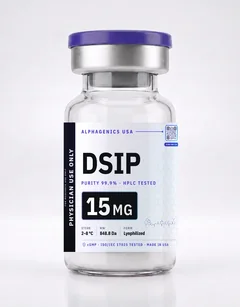
DSIP
W1A2G3G4D5A6S7G8E9
- Molecular formula
- C35H48N10O15
- Molecular weight
- 848.8 g/mol
- CAS number
- 62568-57-4
- PubChem CID
- 68816
- Length
- 9 aa
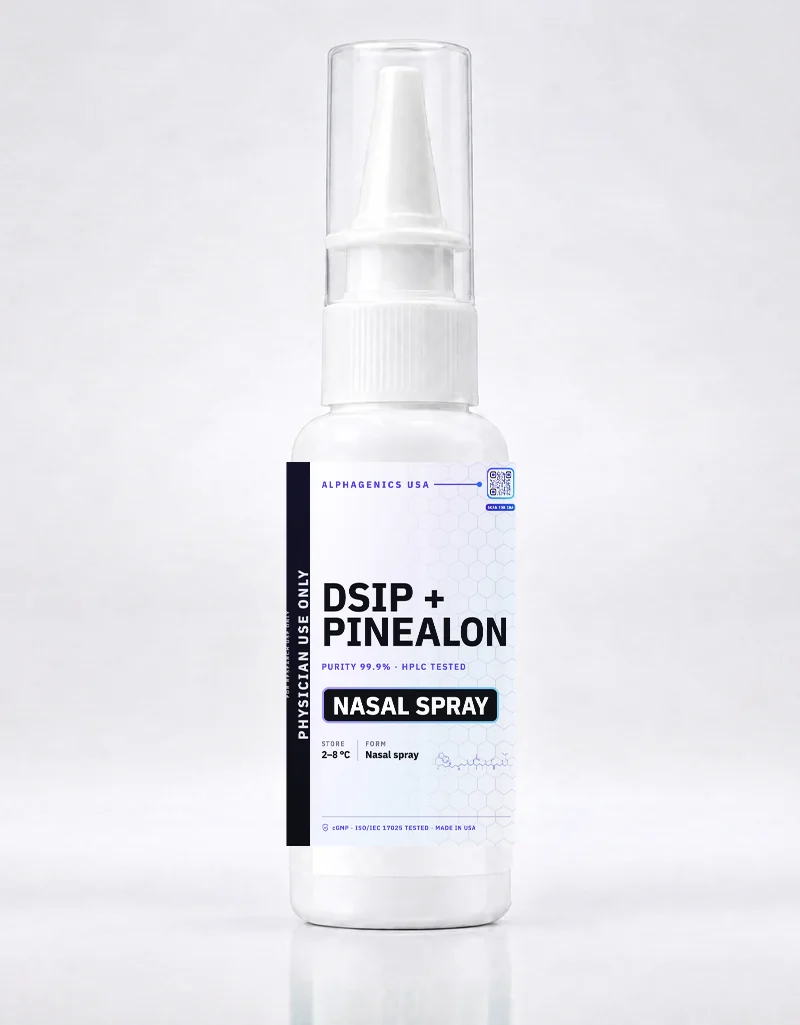
DSIP + Pinealon · DSIP + Glu-Asp-Arg
Combination of a neuromodulatory nonapeptide and a regulatory tripeptide
This spray combines DSIP (delta sleep-inducing peptide), a nonapeptide isolated in 1977 and studied for its possible role in slow-wave sleep and the stress response, with pinealon (Glu-Asp-Arg), a synthetic tripeptide developed in Saint Petersburg and studied in cell and animal models for antioxidant and neuroprotective effects.
The evidence for pinealon is mostly preclinical, and human studies with DSIP have been heterogeneous.
Quick guide · 5 key points
This blend combines DSIP, a nonapeptide studied for its link to deep sleep, with pinealon (Glu-Asp-Arg), a tripeptide studied for its antioxidant effect in nerve cells. Here are five things the research shows.
DSIP (Trp-Ala-Gly-Gly-Asp-Ala-Ser-Gly-Glu) was isolated in 1977 in rabbits for increasing delta waves and sleep spindles on EEG. Pinealon is a synthetic tripeptide (Glu-Asp-Arg) studied in cells for its antioxidant effect. The blend brings together a sleep line of research and a neuroprotection one.1,2
In early studies in patients with insomnia, DSIP injections before sleep were associated with improved sleep, with sleep structure normalizing after four doses. In a double-blind trial of 16 patients with chronic insomnia, the effects were weak, and the authors judged them unlikely to be of major benefit.3,4
After an intravenous injection, DSIP cleared quickly from plasma: a half-life of about 4 minutes in dogs and 2–3 minutes in a monkey and in rats. In rats, a labeled DSIP analogue has been shown to cross the blood-brain barrier.5,6
In cerebellar neurons, neutrophils and PC12 cells under oxidative stress, pinealon was associated with a dose-dependent reduction in reactive oxygen species and in cell death. In the offspring of rats with prenatal hyperhomocysteinemia, giving it to the mothers was associated with better spatial orientation and learning.2,7
No published study has tested the two peptides together. No DSIP gene or receptor has ever been identified, and a review called its role in sleep poorly documented; in 107 patients, tolerance was good apart from headaches in a few. The evidence for pinealon is cell and animal work, almost all from one Russian group.8,9,10
Reference amounts of the formulation. The physicochemical data correspond to each individual peptide.
Summary of results reported in the scientific literature. Each finding describes what was observed in the cited study, in its specific population and conditions; it does not constitute a therapeutic indication.
DSIP: in the original studies in rabbits, isolated DSIP has shown an increase in slow-wave (delta) electroencephalographic activity and in sleep spindles.
Schoenenberger GA, Monnier M. Proc Natl Acad Sci U S A. 1977;74:1282-1286 · PMID 265572DSIP: in patients with insomnia, administration of DSIP has been associated with improved sleep, with a normalization of its structure after several administrations.
Schneider-Helmert D. Eur Neurol. 1984;23:358-363 · PMID 6391925DSIP: in rats subjected to hypoxia, pretreatment with DSIP has been associated with preservation of the respiratory activity of brain mitochondria.
Khvatova EM et al. Peptides. 2003;24:307-311 · PMID 12668217Pinealon: in cerebellar granule cells, neutrophils and PC12 cells under oxidative stress, it has shown a dose-dependent reduction in reactive oxygen species and in necrotic cell death.
Khavinson V et al. Rejuvenation Res. 2011;14:535-541 · PMID 21978084Pinealon: in the offspring of rats with prenatal hyperhomocysteinemia, giving it to the mothers has been associated with better spatial orientation and learning, and with cerebellar neurons more resistant to oxidative stress.
Arutjunyan A et al. Int J Clin Exp Med. 2012;5:179-185 · PMID 22567179