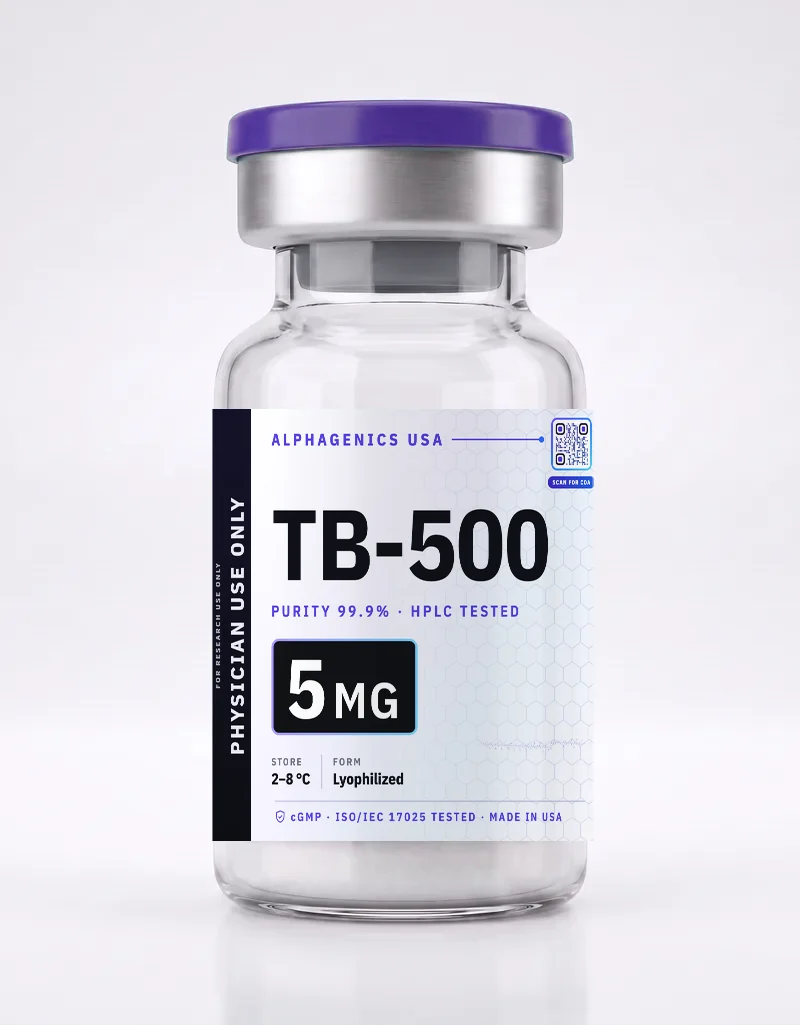
TB-500
Short chain: Ac-LKKTETQ fragment (Tβ4 17-23) · Long chain: full-length thymosin β4 (Tβ4, timbetasin)
G-actin-binding peptide: thymosin β4 fragment (short chain) or full-length thymosin β4 (long chain)
About TB-500
Two different molecules are sold under the name TB-500, and both presentations are available: the short-chain and the long-chain form.
The short-chain form (fragmented TB-500) is the N-acetylated heptapeptide Ac-LKKTETQ, which reproduces the 17-23 sequence of thymosin β4, the region responsible for its actin binding (formula C38H68N10O14; 889.0 g/mol; CAS 885340-08-9; PubChem CID 62707662). The long-chain form is full-length thymosin β4, a 43-amino-acid peptide present in almost every cell of the body and at high concentrations in platelets and leukocytes, whose main known function is to sequester monomeric G-actin, regulating cytoskeletal dynamics and cell migration. Most of the published literature, including all human trials, concerns full-length thymosin β4; for the fragment there are only preclinical and in vitro studies. The physicochemical data and structure below correspond to the long chain, and those of the short chain are listed in separate rows; each finding states which molecule was studied.
Quick guide · 5 key points
TB-500: short chain and long chain
Two molecules are sold under the name TB-500: the N-acetylated fragment Ac-LKKTETQ (short chain) and full-length 43-amino-acid thymosin β4 (long chain). Five points from the research, by molecule studied.
-
1
Two molecules with the same name
The short chain is the N-acetylated fragment Ac-LKKTETQ (7 amino acids; 889 g/mol), the 17-23 sequence of thymosin β4, its active site for actin binding. The long chain is full-length thymosin β4 (43 amino acids; 4963 g/mol), which forms a 1:1 complex with monomeric actin and inhibits its polymerization.1,2,3
7 / 43amino acids: short chain versus long chain -
2
Skin wounds in rodents
Long chain: in rats, full-length thymosin β4 has been associated with 42% more re-epithelialization at day 4 and up to 61% more at day 7 than saline. Short chain: in aged mice, the heptapeptide LKKTETQ (non-acetylated) promoted repair comparable to that of the full-length molecule; in fibroblasts, only the TB-500 metabolite Ac-LKKTE showed significant wound-closure activity (in vitro).4,5,6
+61%re-epithelialization at day 7 with full-length thymosin β4, in rats -
3
Cardiac repair in mice (long chain)
In mice with an induced heart attack, full-length thymosin β4 has been associated with ILK and Akt activation, better cardiomyocyte survival and improved cardiac function. In adult mouse heart explants it has also been shown to mobilize epicardial progenitor cells that form new vessels. No equivalent studies with the fragment were found.7,8
ILK → AktPathway activated in the mouse heart (full-length thymosin β4) -
4
Phase 1: long chain only
A phase 1 study in 40 healthy volunteers compared intravenous synthetic full-length thymosin β4 (42 to 1,260 mg; single dose, then daily for 14 days) with placebo. Adverse events were infrequent and mild or moderate, with no dose-limiting toxicity, and half-life increased with dose. For short-chain TB-500, the FDA identified no pharmacokinetic or clinical studies in humans.9,10
40healthy volunteers, IV phase 1 (full-length thymosin β4 or placebo) -
5
Phase 2: mixed results (long chain)
In 73 patients with venous ulcers, topical full-length thymosin β4 had safety comparable to placebo, and the 0.03% dose may speed healing. In 72 patients with dry eye, it missed its primary endpoints but improved secondary ones. No human trials with the fragment were found.11,12,10
0 of 2primary endpoints met in the dry eye trial
References
- Safer D, et al. Thymosin beta 4 and Fx, an actin-sequestering peptide, are indistinguishable. J Biol Chem. 1991;266(7):4029-32. PMID 1999398
- Ho EN, et al. Doping control analysis of TB-500, a synthetic version of an active region of thymosin β4, in equine urine and plasma by liquid chromatography-mass spectrometry. J Chromatogr A. 2012;1265:57-69. PMID 23084823
- Esposito S, et al. Synthesis and characterization of the N-terminal acetylated 17-23 fragment of thymosin beta 4 identified in TB-500, a product suspected to possess doping potential. Drug Test Anal. 2012;4(9):733-8. PMID 22962027
- Malinda KM, et al. Thymosin beta4 accelerates wound healing. J Invest Dermatol. 1999;113(3):364-8. PMID 10469335
- Philp D, et al. Thymosin beta 4 and a synthetic peptide containing its actin-binding domain promote dermal wound repair in db/db diabetic mice and in aged mice. Wound Repair Regen. 2003;11(1):19-24. PMID 12581423
- Rahaman KA, et al. Simultaneous quantification of TB-500 and its metabolites in in-vitro experiments and rats by UHPLC-Q-Exactive orbitrap MS/MS and their screening by wound healing activities in-vitro. J Chromatogr B Analyt Technol Biomed Life Sci. 2024;1235:124033. PMID 38382158
- Bock-Marquette I, et al. Thymosin beta4 activates integrin-linked kinase and promotes cardiac cell migration, survival and cardiac repair. Nature. 2004;432(7016):466-72. PMID 15565145
- Smart N, et al. Thymosin beta4 induces adult epicardial progenitor mobilization and neovascularization. Nature. 2007;445(7124):177-82. PMID 17108969
- Ruff D, et al. A randomized, placebo-controlled, single and multiple dose study of intravenous thymosin beta4 in healthy volunteers. Ann N Y Acad Sci. 2010;1194:223-9. PMID 20536472
- U.S. Food and Drug Administration. FDA Briefing Document, Pharmacy Compounding Advisory Committee (PCAC) meeting, July 23-24, 2026: FDA Evaluation of TB-500-Related Bulk Drug Substances (TB-500 (Free Base) and TB-500 acetate). Official source
- Guarnera G, et al. The effect of thymosin treatment of venous ulcers. Ann N Y Acad Sci. 2010;1194:207-12. PMID 20536470
- Sosne G, Ousler GW. Thymosin beta 4 ophthalmic solution for dry eye: a randomized, placebo-controlled, Phase II clinical trial conducted using the controlled adverse environment (CAE) model. Clin Ophthalmol. 2015;9:877-84. PMID 26056426
Structure and sequence
Sequence
Ac-SDKPDMAEIEKFDKSKLKKTETQEKNPLPSKETIEQEKQAGES
Large molecule (4963.4 g/mol): the full structure is shown above; the sequence summarizes its amino-acid order. 3D model available on PubChem.

Five findings from studies
Summary of results reported in the scientific literature. Each finding describes what was observed in the cited study, in its specific population and conditions; it does not constitute a therapeutic indication.
-
Preclinical
Long chain (full-length thymosin β4): in a rat skin wound model, it has shown an increase in re-epithelialization of 42% at day 4 and of up to 61% at day 7 versus control.
Malinda KM et al. J Invest Dermatol. 1999;113:364-368 · PMID 10469335 -
Preclinical
Long chain (full-length thymosin β4): in mice after coronary artery ligation, treatment has been associated with greater ILK and Akt activity in the heart, greater early cardiomyocyte survival and better cardiac function; in culture, it promoted cardiomyocyte migration and survival.
Bock-Marquette I et al. Nature. 2004;432:466-472 · PMID 15565145 -
Preclinical
Short chain and long chain: in aged (26-month-old) mice with full-thickness dermal wounds, full-length thymosin β4 has been associated with faster healing, with greater keratinocyte migration, wound contraction and collagen deposition; the synthetic heptapeptide LKKTETQ (the sequence of short-chain TB-500, without the N-terminal acetylation) promoted repair comparable to that of the full-length molecule.
Philp D et al. Wound Repair Regen. 2003;11:19-24 · PMID 12581423 -
Clinical study
Long chain (full-length thymosin β4): in a phase 2 trial in 73 patients with venous ulcers, topical Tβ4 showed safety comparable to placebo, and it has been observed that the 0.03% dose might accelerate healing.
Guarnera G et al. Ann N Y Acad Sci. 2010;1194:207-212 · PMID 20536470 -
Regulatory
Short chain (Ac-LKKTETQ): in its 2026 evaluation for the Pharmacy Compounding Advisory Committee (PCAC), the FDA identified no clinical or pharmacokinetic studies of TB-500 in humans and no in vivo wound-healing studies; it did identify an in vitro study in which TB-500 (50 µg/mL) did not induce wound closure in fibroblasts, whereas its metabolite Ac-LKKTE appeared to do so.
FDA. Briefing Document, Pharmacy Compounding Advisory Committee, July 23-24, 2026: TB-500-Related Bulk Drug Substances