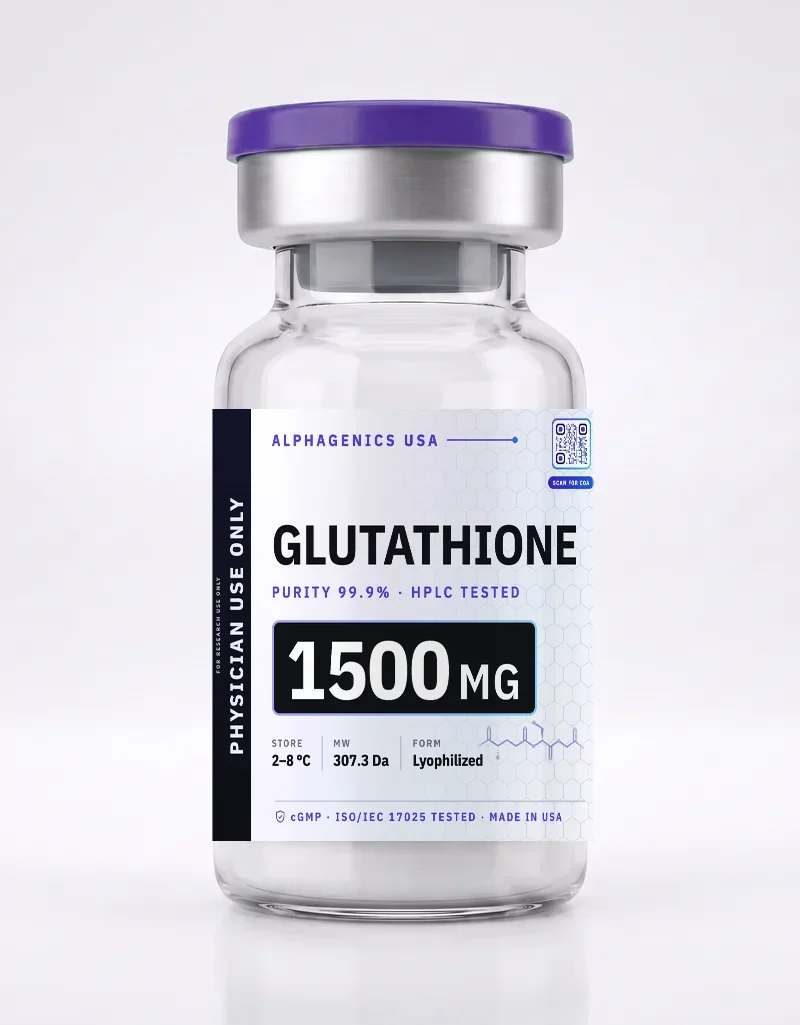
Glutathione
Glutatión · GSH · Reduced L-glutathione
Endogenous antioxidant tripeptide (γ-glutamyl-cysteinyl-glycine)
About Glutathione
Glutathione (GSH) is a tripeptide made of glutamic acid, cysteine and glycine, with an unusual γ-glutamyl bond between the first two amino acids.
It is the most abundant endogenous antioxidant and takes part in cellular redox balance, usually expressed as the ratio between its reduced (GSH) and oxidized (GSSG) forms. Human evidence comes from small oral, intranasal and intravenous trials, with results that vary by route and by the outcome measured.
Structure and sequence
Sequence

Five findings from studies
Summary of results reported in the scientific literature. Each finding describes what was observed in the cited study, in its specific population and conditions; it does not constitute a therapeutic indication.
-
Clinical study
In a 6-month randomized, placebo-controlled trial (54 non-smoking adults), oral glutathione (250 or 1000 mg/day) has been associated with higher body stores in blood; at the high dose, levels rose 30–35% in erythrocytes, plasma and lymphocytes, and returned to baseline after a 1-month washout.
Richie JP Jr et al. Eur J Nutr. 2015;54:251-263 · PMID 24791752 -
Clinical study
In another randomized, placebo-controlled trial (40 healthy adults, 500 mg orally twice daily for 4 weeks), no significant changes were observed in oxidative stress biomarkers or in erythrocyte glutathione; this result is reported for a complete reading of the evidence.
Allen J, Bradley RD. J Altern Complement Med. 2011;17:827-833 · PMID 21875351 -
Clinical study
In a randomized, double-blind pilot trial in 21 patients with Parkinson disease, intravenous glutathione (1400 mg three times a week for 4 weeks) was well tolerated, with no significant differences versus placebo on the UPDRS scale.
Hauser RA et al. Mov Disord. 2009;24:979-983 · PMID 19230029 -
Clinical study
In a phase IIb trial (45 patients with Parkinson disease, 3 months), all groups improved on the UPDRS scale, including placebo, and neither intranasal glutathione dose was superior to placebo.
Mischley LK et al. J Parkinsons Dis. 2017;7:289-299 · PMID 28436395 -
Clinical study
In healthy women (12-week randomized, placebo-controlled trial), oral glutathione at 250 mg/day, in reduced or oxidized form, has been associated with a trend toward a lower melanin index and, at some sites, a significant reduction in wrinkles versus placebo.
Weschawalit S et al. Clin Cosmet Investig Dermatol. 2017;10:147-153 · PMID 28490897