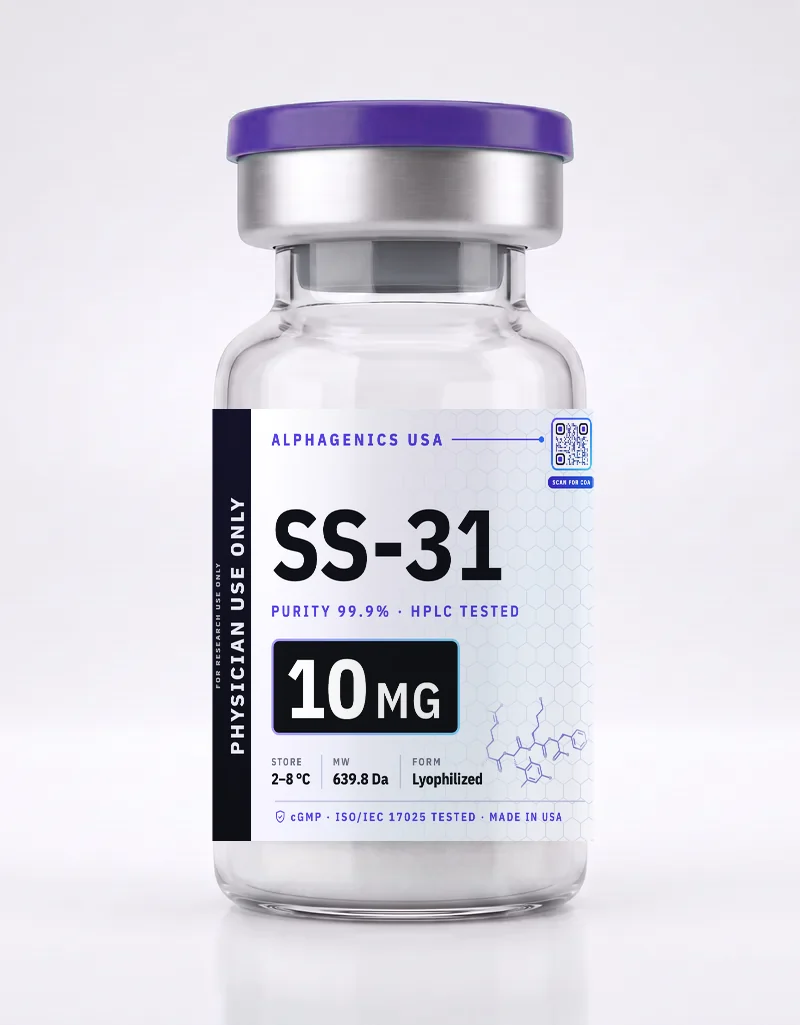
SS-31
Elamipretide · MTP-131 · Bendavia
Mitochondria-targeted tetrapeptide (cardiolipin ligand)
About SS-31
SS-31 (elamipretide) is an aromatic-cationic tetrapeptide that crosses cell membranes and concentrates in the inner mitochondrial membrane, where it binds to cardiolipin, a phospholipid essential for the organization of the respiratory chain.
This interaction has been associated with stabilization of the mitochondrial cristae, greater efficiency in ATP production and lower generation of reactive oxygen species. In September 2025 the FDA granted accelerated approval to elamipretide (Forzinity) to improve muscle strength in patients with Barth syndrome.
Quick guide · 5 key points
SS-31 and mitochondrial energy
SS-31 (elamipretide) is a tetrapeptide that concentrates in the inner membrane of the mitochondria, where it binds cardiolipin. Here are five things the research shows.
-
1
It binds cardiolipin inside the mitochondria
SS-31 has been shown to bind cardiolipin with high affinity. Cardiolipin is a phospholipid of the inner mitochondrial membrane needed to form the cristae. The complex inhibits cytochrome c peroxidase activity, which damages that membrane. In rats, it protected the cristae during kidney ischemia.1
CardiolipinThe mitochondrial phospholipid that SS-31 binds -
2
Aged muscle, energy restored within an hour
In 27-month-old mice, a single dose of SS-31 was associated with mitochondrial ATP production restored to young levels within one hour, and muscle that resisted fatigue better. After 8 days, endurance capacity was higher. It had no effect in young mice.2
1 hourTo restored muscle energetics after one dose in mice -
3
Age-related heart dysfunction reversed
In old mice, 8 weeks of SS-31 was associated with reversal of diastolic dysfunction, a hallmark of the aging heart, with less mitochondrial reactive oxygen species in heart muscle cells.3
8 weeksof treatment in old mice in this study -
4
A trial in Barth syndrome
In the TAZPOWER trial (12 patients with Barth syndrome, 40 mg/day), the 12-week randomized phase did not meet its primary endpoints. In the open-label extension, the 8 patients who reached 36 weeks showed +95.9 m on the 6-minute walk test.4
+95.9 mon the 6-minute walk at 36 weeks (open-label extension) -
5
FDA approval in 2025, on limited data
The FDA granted accelerated approval in 2025 (Forzinity®) for muscle strength in Barth syndrome, based on knee extensor strength in the open-label extension. The most common side effects were injection site reactions (redness in 12 of 12 patients). The approval rests on just 12 patients; the rest of the data in this guide are from animals.5,4,2,3
2025FDA accelerated approval, based on 12 patients
References
- Birk AV, et al. The mitochondrial-targeted compound SS-31 re-energizes ischemic mitochondria by interacting with cardiolipin. J Am Soc Nephrol. 2013;24(8):1250-61. PMID 23813215
- Siegel MP, et al. Mitochondrial-targeted peptide rapidly improves mitochondrial energetics and skeletal muscle performance in aged mice. Aging Cell. 2013;12(5):763-71. PMID 23692570
- Chiao YA, et al. Late-life restoration of mitochondrial function reverses cardiac dysfunction in old mice. eLife. 2020;9:e55513. PMID 32648542
- Reid Thompson W, et al. A phase 2/3 randomized clinical trial followed by an open-label extension to evaluate the effectiveness of elamipretide in Barth syndrome, a genetic disorder of mitochondrial cardiolipin metabolism. Genet Med. 2021;23(3):471-478. PMID 33077895
- U.S. Food and Drug Administration. Forzinity (elamipretide) injection prescribing information. NDA 215244, 2025. Official source
Structure and sequence
Sequence

Five findings from studies
Summary of results reported in the scientific literature. Each finding describes what was observed in the cited study, in its specific population and conditions; it does not constitute a therapeutic indication.
-
Regulatory
In 2025 the FDA granted accelerated approval to elamipretide to improve muscle strength in patients with Barth syndrome weighing at least 30 kg, based on an improvement in knee extensor muscle strength (an intermediate clinical endpoint) observed in an open-label extension.
FDA. Forzinity (elamipretide) — prescribing information, NDA 215244 -
In vitro
In biophysical studies, SS-31 has shown high-affinity binding to cardiolipin and inhibition of the peroxidase activity of cytochrome c, which damages mitochondrial membranes.
Birk AV et al. J Am Soc Nephrol. 2013;24:1250-1261 · PMID 23813215 -
Preclinical
In aged mice, a single administration of SS-31 has been associated with reversal, within one hour, of mitochondrial energy dysfunction in skeletal muscle and with greater resistance to muscle fatigue; after 8 days of treatment, greater exercise endurance capacity was observed.
Siegel MP et al. Aging Cell. 2013;12:763-771 · PMID 23692570 -
Preclinical
In aged mice, 8 weeks of treatment with SS-31 has been associated with reversal of age-related diastolic dysfunction.
Chiao YA et al. eLife. 2020;9:e55513 · PMID 32648542 -
Clinical study
In the TAZPOWER trial in patients with Barth syndrome, the randomized phase did not meet its primary endpoints, but the open-label extension (8 patients at 36 weeks) has been associated with improvements in 6-minute walk distance and in knee extension strength.
Reid Thompson W et al. Genet Med. 2021;23:471-478 · PMID 33077895