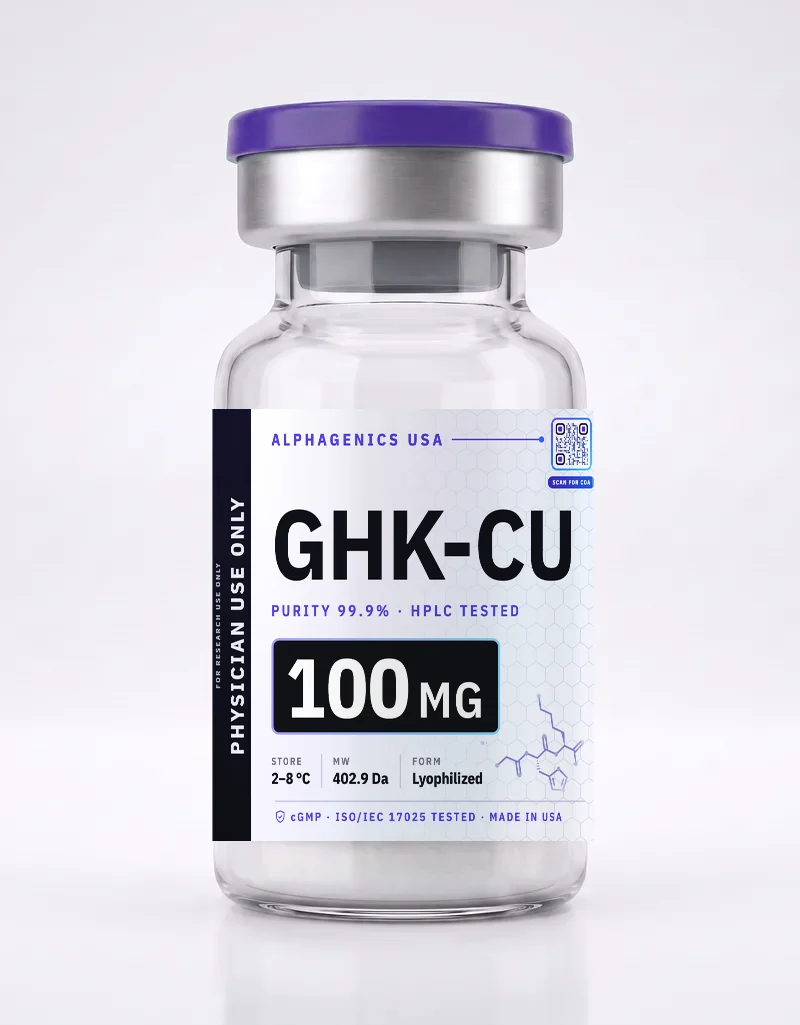
GHK-Cu
Copper peptide · Copper prezatide · Glycyl-L-histidyl-L-lysine-Cu(II)
Tripeptide-copper complex
About GHK-Cu
GHK-Cu is the complex of the tripeptide glycyl-L-histidyl-L-lysine (GHK) with the copper(II) ion.
GHK was isolated from human plasma in 1973 and, according to reviews, its levels decline with age: from an average of about 200 ng/mL at age 20 to about 80 ng/mL at age 60. Because of its high affinity for copper, it takes part in transporting this ion into cells and has been widely studied in tissue remodeling, collagen synthesis, wound healing and skin care.
Quick guide · 5 key points
GHK-Cu: the copper peptide
GHK-Cu is a tripeptide found in human plasma that binds copper and has been studied for collagen, wound healing and skin. Here are five things the research shows.
-
1
A human tripeptide that binds copper
GHK (glycyl-histidyl-lysine) was isolated from human plasma in 1973 and forms a complex with the copper (II) ion. It is also found in saliva and urine, and its levels decline with age.1,2,5
1973Year GHK was identified in human plasma -
2
More collagen in human fibroblasts
In cultured fibroblasts, GHK-Cu has been associated with increased collagen synthesis starting at 10⁻¹² to 10⁻¹¹ M, with a peak at 10⁻⁹ M (nanomolar). The effect did not depend on a change in cell number.2
10⁻⁹ MConcentration of peak collagen stimulation in culture -
3
More repair matrix in rat wounds
In wound chambers implanted in rats, GHK-Cu has been associated with a concentration-dependent increase in collagen, glycosaminoglycans and total protein. Collagen stimulation was twice that of other proteins, with more type I and type III collagen mRNA.3
2×Collagen stimulation versus other proteins, in rats -
4
Faster closure of ischemic wounds
In 24 rats with ischemic wounds, wound area shrank by 64.5% with topical GHK-Cu by day 13, versus 45.6% with the vehicle and 28.2% with no treatment. Treated wounds had lower TNF-α and metalloproteinases (MMP-2 and MMP-9).4
64.5%Reduction in wound area by day 13, in rats -
5
Skin data and strength of evidence
Reviews describe controlled studies on aged skin in which GHK-Cu has been associated with firmer, more elastic skin and fewer fine lines, and gene data linking it to at least 4,000 human genes. Most of the evidence is from cells and animals, and the reviews come mainly from the group that discovered the peptide.6,5
4,000+Human genes whose expression has been associated with GHK
References
- Pickart L, Thaler MM. Tripeptide in human serum which prolongs survival of normal liver cells and stimulates growth in neoplastic liver. Nat New Biol. 1973;243(124):85-7. PMID 4349963
- Maquart FX, et al. Stimulation of collagen synthesis in fibroblast cultures by the tripeptide-copper complex glycyl-L-histidyl-L-lysine-Cu2+. FEBS Lett. 1988;238(2):343-6. PMID 3169264
- Maquart FX, et al. In vivo stimulation of connective tissue accumulation by the tripeptide-copper complex glycyl-L-histidyl-L-lysine-Cu2+ in rat experimental wounds. J Clin Invest. 1993;92(5):2368-76. PMID 8227353
- Canapp SO Jr, et al. The effect of topical tripeptide-copper complex on healing of ischemic open wounds. Vet Surg. 2003;32(6):515-23. PMID 14648529
- Pickart L, et al. GHK peptide as a natural modulator of multiple cellular pathways in skin regeneration. Biomed Res Int. 2015;2015:648108. PMID 26236730
- Pickart L. The human tri-peptide GHK and tissue remodeling. J Biomater Sci Polym Ed. 2008;19(8):969-88. PMID 18644225
Structure and sequence
Sequence

Five findings from studies
Summary of results reported in the scientific literature. Each finding describes what was observed in the cited study, in its specific population and conditions; it does not constitute a therapeutic indication.
-
In vitro
In cultured human fibroblasts, GHK-Cu has shown increased collagen synthesis at very low (nanomolar) concentrations.
Maquart FX et al. FEBS Lett. 1988;238:343-346 · PMID 3169264 -
Preclinical
In a rat wound chamber model, administration of GHK-Cu has been associated with a concentration-dependent increase in the content of collagen, glycosaminoglycans and total protein in the repair tissue.
Maquart FX et al. J Clin Invest. 1993;92:2368-2376 · PMID 8227353 -
Preclinical
In an ischemic wound model in 24 rats, topical application of GHK-Cu has been associated with a greater reduction in wound area at day 13 (64.5% versus 45.6% with vehicle and 28.2% with no treatment) and lower concentrations of TNF-α and metalloproteinases (MMP-2 and MMP-9).
Canapp SO et al. Vet Surg. 2003;32:515-523 · PMID 14648529 -
Review
In computational gene expression analyses (Connectivity Map, based on human tumor cell lines), GHK has been associated with modulation of the expression of a large number of human genes related to tissue repair and the antioxidant response.
Pickart L et al. Biomed Res Int. 2015;2015:648108 · PMID 26236730 -
In vitro
GHK was identified in human plasma as a factor that prolongs the survival of normal liver cells in culture.
Pickart L, Thaler MM. Nat New Biol. 1973;243:85-87 · PMID 4349963