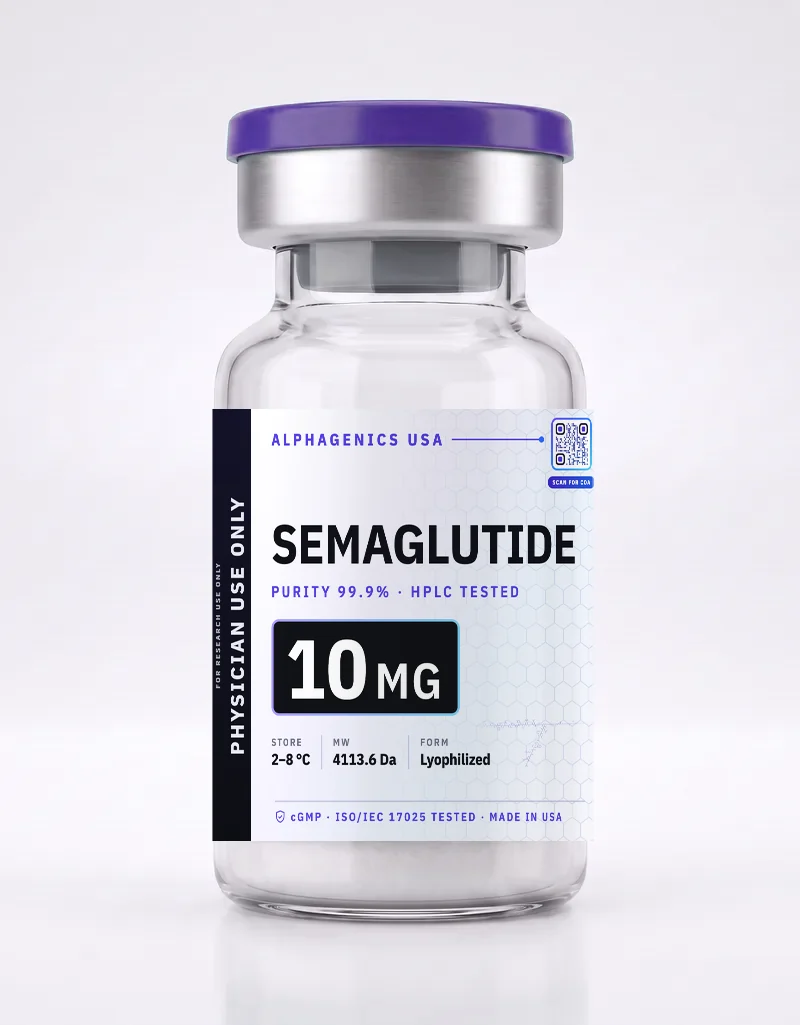
Semaglutide
NN9535
GLP-1 receptor agonist (acylated GLP-1 analog)
About Semaglutide
Semaglutide is an analog of human glucagon-like peptide-1 (GLP-1) with 94% sequence homology to the native hormone.
It is set apart by two amino-acid substitutions (α-aminoisobutyric acid (Aib) instead of alanine at position 8, which protects it from degradation by the enzyme DPP-4, and arginine instead of lysine at position 34) and by the acylation of lysine 26 with a C18 fatty-acid chain attached through a spacer, which favors its reversible binding to plasma albumin. These modifications extend its half-life to approximately one week. It is one of the most studied molecules in its class, with large-scale clinical programs in metabolism, cardiovascular risk and kidney function.
Quick guide · 5 key points
Semaglutide and metabolic health
Semaglutide is a GLP-1 analog built to stay active for a full week. Here are five things the research shows.
-
1
A GLP-1 modified to last a week
Semaglutide differs from human GLP-1 at two amino acids and carries a fatty-acid chain that increases its binding to albumin. It was designed this way for once-weekly action. The SUSTAIN-6 trial describes a half-life of about one week.1,2
≈ 1 weekHalf-life reported in the SUSTAIN-6 trial -
2
Average weight loss of almost 15%
In the STEP 1 trial (1,961 adults with obesity or overweight, without diabetes, 68 weeks), semaglutide 2.4 mg weekly was associated with an average weight reduction of 14.9%, compared with 2.4% on placebo. Half of participants (50.5%) lost 15% or more.3
−14.9%Average weight change over 68 weeks (placebo: −2.4%) -
3
Fewer cardiovascular events, even without diabetes
In the SELECT trial (17,604 adults with cardiovascular disease and overweight or obesity, without diabetes), semaglutide was associated with 20% fewer cardiovascular deaths, nonfatal heart attacks or nonfatal strokes than placebo, over a mean follow-up of 39.8 months.4
−20%Risk of major cardiovascular events (hazard ratio 0.80) -
4
Effects studied in the kidney and the heart
In the FLOW trial (3,533 patients with type 2 diabetes and chronic kidney disease), the risk of major kidney events was 24% lower than with placebo. In STEP-HFpEF (529 patients with heart failure with preserved ejection fraction and obesity), fewer symptoms and better exercise capacity were observed.5,6
−24%Risk of major kidney events in the FLOW trial -
5
Side effects are mostly digestive
In STEP 1, the most common side effects were nausea and diarrhea, usually short-lived and mild to moderate. 4.5% stopped treatment because of gastrointestinal effects (0.8% on placebo). In SUSTAIN-6, in type 2 diabetes, more retinopathy complications were seen than with placebo.3,2
4.5%Stopped for digestive effects in STEP 1 (placebo: 0.8%)
References
- Lau J, et al. Discovery of the once-weekly glucagon-like peptide-1 (GLP-1) analogue semaglutide. J Med Chem. 2015;58(18):7370-80. PMID 26308095
- Marso SP, et al. Semaglutide and cardiovascular outcomes in patients with type 2 diabetes. N Engl J Med. 2016;375(19):1834-44. PMID 27633186
- Wilding JPH, et al. Once-weekly semaglutide in adults with overweight or obesity. N Engl J Med. 2021;384(11):989-1002. PMID 33567185
- Lincoff AM, et al. Semaglutide and cardiovascular outcomes in obesity without diabetes. N Engl J Med. 2023;389(24):2221-32. PMID 37952131
- Perkovic V, et al. Effects of semaglutide on chronic kidney disease in patients with type 2 diabetes. N Engl J Med. 2024;391(2):109-21. PMID 38785209
- Kosiborod MN, et al. Semaglutide in patients with heart failure with preserved ejection fraction and obesity. N Engl J Med. 2023;389(12):1069-84. PMID 37622681
Structure and sequence
Sequence
Large molecule (4113.6 g/mol): the full structure is shown above; the sequence summarizes its amino-acid order. 3D model available on PubChem.

Five findings from studies
Summary of results reported in the scientific literature. Each finding describes what was observed in the cited study, in its specific population and conditions; it does not constitute a therapeutic indication.
-
Clinical study
In the STEP 1 trial (1,961 adults with obesity or overweight, 68 weeks), semaglutide 2.4 mg once weekly has shown a mean body-weight reduction of 14.9%, versus 2.4% with placebo.
Wilding JPH et al. N Engl J Med. 2021;384:989-1002 (STEP 1) · PMID 33567185 -
Clinical study
In the SELECT trial (17,604 adults with cardiovascular disease and overweight or obesity, without diabetes), a 20% reduction in major adverse cardiovascular events versus placebo has been shown.
Lincoff AM et al. N Engl J Med. 2023;389:2221-2232 (SELECT) · PMID 37952131 -
Clinical study
In the SUSTAIN-6 trial (3,297 patients with type 2 diabetes), a 26% reduction in the composite endpoint of cardiovascular death, non-fatal myocardial infarction or non-fatal stroke has been observed.
Marso SP et al. N Engl J Med. 2016;375:1834-1844 (SUSTAIN-6) · PMID 27633186 -
Clinical study
In the FLOW trial (3,533 patients with type 2 diabetes and chronic kidney disease), a 24% reduction in the composite primary endpoint of major kidney disease events (kidney failure, a decrease of at least 50% in eGFR, or death from kidney-related or cardiovascular causes) has been shown.
Perkovic V et al. N Engl J Med. 2024;391:109-121 (FLOW) · PMID 38785209 -
Clinical study
In the STEP-HFpEF trial (529 patients with heart failure with preserved ejection fraction and obesity), an improvement in symptoms, physical limitation and exercise capacity versus placebo has been observed.
Kosiborod MN et al. N Engl J Med. 2023;389:1069-1084 (STEP-HFpEF) · PMID 37622681